The Executive Drain: Using Choice Architecture to Combat Decision Fatigue
You have successfully scaled a business, managed a team of thirty, and navigated complex market shifts, yet you cannot seem to maintain a consistent meditation practice or stop checking your emails at 10:00 PM. This paradox is not a reflection of your character or a sudden collapse of your discipline. It is a predictable neurological phenomenon known as Executive Drain. When your professional life demands high-frequency, high-stakes decision-making, your capacity for personal behavioral change is the first thing to be sacrificed at the altar of cognitive exhaustion.
The Neurological Ceiling: Why Willpower Failure is a System Error
To understand why you feel stuck in automatic routines, we must look at the dorsolateral prefrontal cortex (DLPFC). This region of the brain is the seat of executive function—the mental capacity required for planning, impulse control, and complex decision-making. Research in neuroscience suggests that the DLPFC operates much like a battery. Every choice you make, from the trivial color of a slide deck to the critical pivoting of a company strategy, draws from this limited power supply.
By the time an entrepreneur finishes their workday, their DLPFC is often depleted. This state, known as decision fatigue, triggers a survival mechanism where the brain seeks to conserve energy by reverting to 'automatic scripts.' These are the deeply ingrained habits and default behaviors that require zero cognitive effort to execute. If your script involves ordering takeout and scrolling through social media, that is exactly what you will do when your executive battery hits zero, regardless of how much motivation you felt at 8:00 AM. This is not a willpower failure; it is a system overload.
Choice Architecture: Beyond the Friction Audit
In our previous discussions, we explored the 'Friction Audit,' which focuses on removing physical obstacles from your path. Choice Architecture is a distinct, complementary discipline. While a friction audit might involve removing junk food from your pantry to stop you from eating it, Choice Architecture involves designing the 'context' in which you make decisions to nudge your brain toward a specific outcome without requiring active willpower.
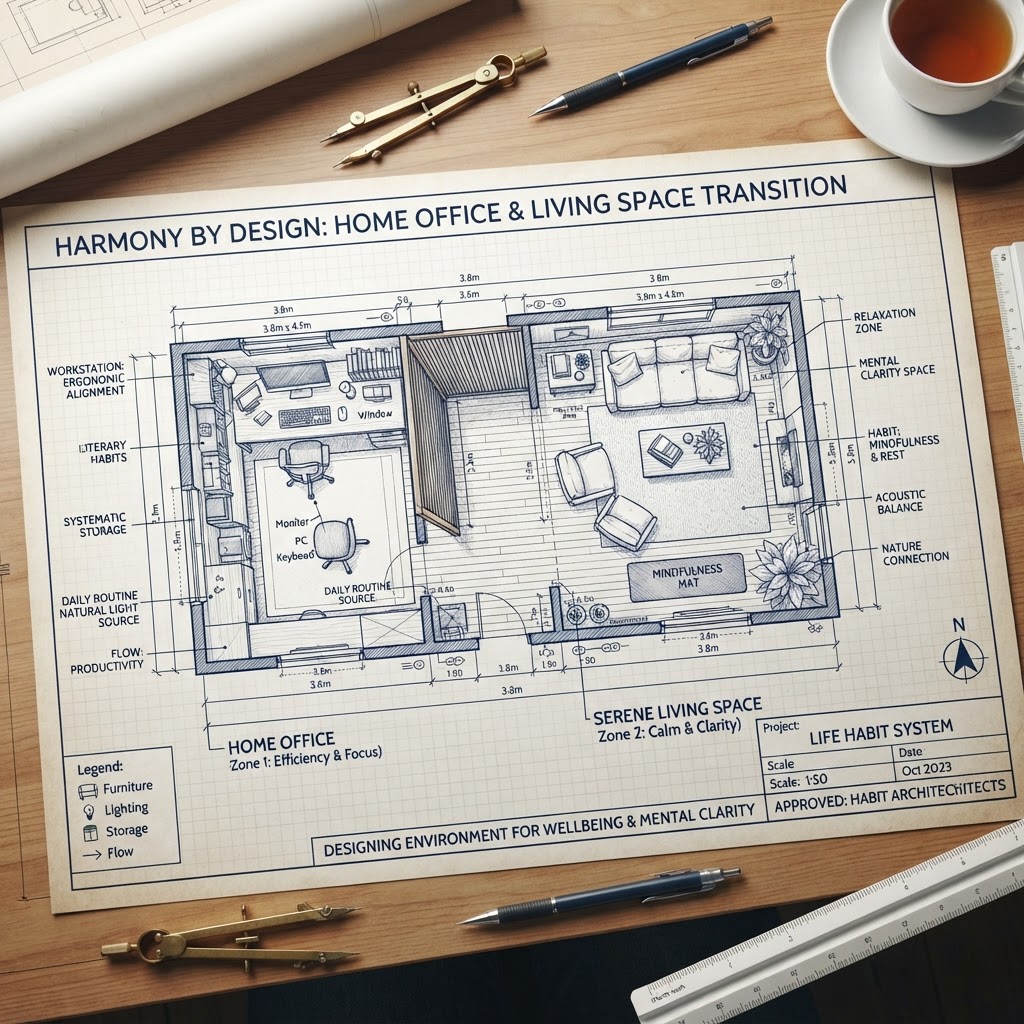
Think of it as the difference between a contractor and an architect. The contractor removes the debris (Friction Audit), but the architect designs the flow of the building so that you naturally walk into the rooms that serve you best. For the individual looking to reprogram their life, Choice Architecture means pre-arranging the choices of your future self while you are still in a high-energy, rational state. It is the systematic redesign of your environment so that the 'easiest' path is also the most beneficial one.
The Self-Architect Framework
To implement this, you must adopt the 'Self-Architect' mindset. This requires you to step outside of your current struggle and view your daily life as a third-party consultant would. You are not the worker in the system; you are the engineer who designs the system the worker operates within. The goal is to reduce the 'activation energy'—the initial spark of effort required to start a new behavior—by making the desired action the default choice.
1. Design for the 'Future Self'
We often treat our future selves as if they will have more energy, more discipline, and more time than we do now. The Self-Architect does the opposite. You must assume that your 6:00 PM self will be exhausted, irritable, and looking for the path of least resistance. Architecture, in this sense, involves preparing the environment for that specific person. If you want to exercise after work, Choice Architecture is not just about putting your shoes by the door; it is about choosing a gym that is literally on your route home, ensuring you never have to make the 'choice' to turn off your path.
2. The Power of Default Options
In behavioral economics, the 'default option' is the choice that is automatically selected if an individual does nothing. You can apply this to your digital and physical life. If your phone is the first thing you reach for in the morning, your current architecture has made 'distraction' the default. By placing your phone in a timed lockbox in another room and putting a physical book or a journal on your nightstand, you have changed the default. You are not using willpower to avoid the phone; you are simply existing in an environment where the phone is no longer a viable immediate choice.
3. Visual Salience and Decision Nudging
The brain is highly responsive to visual cues when cognitive energy is low. Choice Architecture uses 'visual salience' to push desired behaviors to the front of the queue. If you want to drink more water, you don't just 'try harder' to remember. You place three filled carafes in the three locations where you spend the most time. The visual presence of the water acts as a nudge, reducing the cognitive load of remembering the habit and making the act of drinking effortless.
Implementing Architectural Shifts in a High-Stakes Life
For entrepreneurs, the most critical architectural shifts happen at the transition points between professional and personal life. The 'Executive Drain' is most dangerous during these gaps. To bridge them, you must create 'Environmental Bumpers' that prevent you from sliding back into old scripts.
One effective architectural shift is the 'Shutdown Protocol.' Instead of working until you are too tired to continue, you set a firm architectural boundary—perhaps an automated script that shuts down your computer at a specific time or a physical relocation to a 'non-work' zone of your home. By creating these boundaries, you preserve the small amount of executive energy you have left for your personal life redesign rather than letting it bleed out into one last unnecessary email.
Conclusion: Change the System, Keep Your Humanity
Reprogramming your life is not about becoming a robot or having an iron will. It is about acknowledging that you are human, and that your human brain has finite limits. When you stop fighting against your biology and start designing around it, the friction of behavioral change begins to dissipate. You are no longer the victim of your automatic scripts; you are the architect of a new reality.
Stop relying on the same willpower that you exhausted during your board meetings. Instead, start building the structures that support your growth when you are at your weakest. Stop running the program that built your old life. Design a new one. Stop running the program that built your old life.