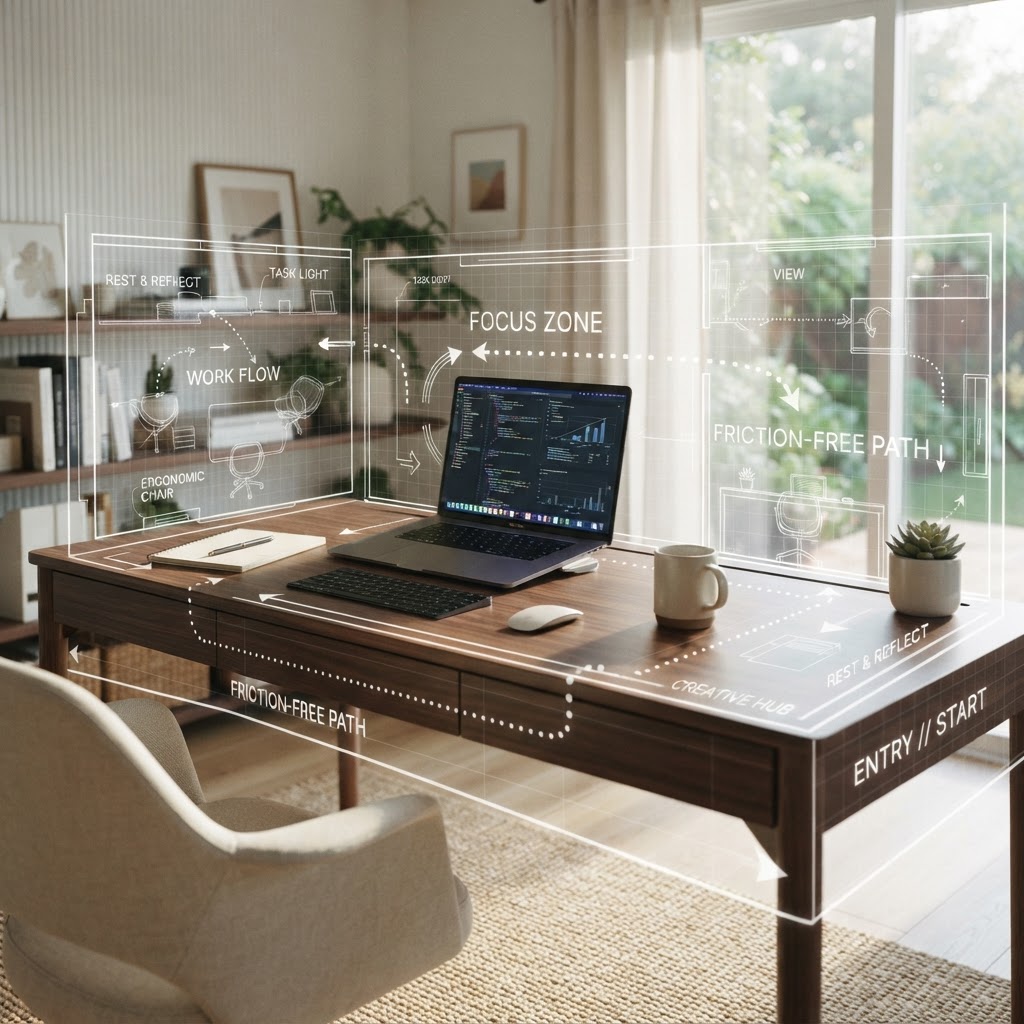
Stop Trying Harder, Start Designing Smarter
We have all been there: the surge of motivation at 11:00 PM, the promise that 'tomorrow is a new day,' and the eventual, frustrating return to old patterns by Wednesday afternoon. For years, the self-improvement industry has told us that if we fail to change, it is a deficit of character or a lack of grit. We are told to 'want it more.'
At Reprogram Your Life, we look at things differently. We view your life not as a series of moral tests, but as an operating system. If a piece of software consistently crashes, a professional developer doesn't yell at the code; they look for the bug in the architecture. When your daily routines feel stuck in a loop, the problem isn't your motivation—it is the environment in which your habits operate. It is time to stop the cycle of willpower failure and start focusing on environmental design.
The Willpower Fallacy
The American Psychological Association notes that willpower is often misunderstood as a static trait. In reality, willpower is a finite cognitive resource. Every decision you make—from what to wear in the morning to how to respond to a difficult email—depletes this reserve. This phenomenon, known as decision fatigue, means that by the time you face a choice between a healthy habit and a comfortable one in the evening, your 'willpower battery' is likely at zero.
Relying on willpower for long-term behavioral change is like trying to run a marathon while holding your breath. You might make it a few hundred yards on sheer determination, but eventually, biology takes over. To create lasting change, we must move away from 'trying harder' and toward 'designing better.'
The Power of Choice Architecture
If you cannot rely on your internal strength to drive change, what can you rely on? The answer lies in Choice Architecture. This concept suggests that the way options are presented to us—our physical and digital surroundings—dictates our behavior more than our conscious intentions.
Think of your environment as the invisible hand that guides your focus. If your phone is the first thing you touch in the morning because it sits on your nightstand, you have designed a life where social media consumption is the default. By simply moving that phone to another room, you change the architecture of your morning. You haven't gained more willpower; you've simply changed the blueprints of your space.
The Physics of Friction
In behavioral science, 'friction' refers to the number of steps required to complete a task. To reprogram your life, you must apply the laws of friction systematically:
- Decrease Friction for Positive Habits: If you want to exercise in the morning, lay out your clothes and shoes the night before. By removing the three-minute hurdle of finding your gear, you increase the likelihood of the habit by an order of magnitude.
- Increase Friction for Negative Habits: If you find yourself mindlessly browsing the web during work hours, log out of all your accounts and use a browser extension that blocks certain sites. The 'friction' of having to manually type a password or disable a block is often enough to break the automatic impulse.
As highlighted in recent research on habit formation, making a behavior just 20 seconds easier or harder can be the difference between success and failure. You are not fighting your nature; you are simply adjusting the resistance of the path.
For Entrepreneurs: Your Schedule as a User Interface
For the entrepreneur, the 'environment' isn't just a physical office; it is your digital workspace and your calendar. Many professionals treat their schedules like a reactive dumping ground for other people's priorities. To reclaim your focus, you must treat your schedule as a User Interface (UI).
Does your current UI make it easy to reach 'Deep Work,' or is the 'Distraction' button front and center? Systemic change involves auditing every touchpoint of your day. If your email notifications are always on, you have designed an environment that rewards interruption. By turning them off and batching communications, you are reprogramming the system to prioritize high-leverage tasks over reactive busywork.
Becoming the Architect of Your Life
It is important to acknowledge that this approach is not about avoiding responsibility. On the contrary, it is about taking a higher level of responsibility. Instead of being a victim of your impulses, you become the Architect of your outcomes. This transition takes time. While the logic of environmental design is immediate, the neuroplasticity required for these new patterns to feel 'natural' can take weeks or months.
Change the system. Keep your humanity. You do not need to be a machine to be productive; you simply need a better environment to support your human needs. When the system works, you don't have to fight yourself every day. You can simply live.
Are you ready to stop the struggle?
Design a life that works for you, not against you. Start by identifying the 'bugs' in your current daily routine and replacing them with systemic solutions.
Take the free Life Audit today and discover where your environment is holding you back: https://reprogramyourlife.cloud/life-audit